The King Jesus Trilogy · Vol. 1 · 2006
“You don’t have to agree, just very interesting history.”Marv, a reader on Goodreads.
1 of 5Next
King Jesus continues the historical identification begun in this volume.
Why was the birth of a carpenter attended by Persian king-makers, and why was the child later called King of the Jews? Cleopatra to Christ, the first volume of the King Jesus Trilogy, reconstructs a royal line from Cleopatra VII through her daughter into Judaea, with Roman and Parthian ancestry besides. Ellis reads the Magi as a Parthian political embassy, not as rustic witnesses in a nativity play, and he argues that Jesus was descended from Cleopatra. The genealogy is his proposal. It is not the consensus of historians of the first century. The book is for readers who want the historical identity of Jesus, Cleopatra’s descendants, and first-century royal politics set out as one investigation.
What you'll explore
- Jesus descended from Cleopatra VII
- Aristocratic Roman and royal Persian ancestry
- The Magi as Parthian king-makers, not rustic witnesses
ISBN 9781508465881
In the journal
On Ancient Origins
- The Royal Lineage Of Jesus, Descendant Of Cleopatra — 26 March 2021. Their page, not a chapter pasted here.
- The Celestial Snow White: Mary Magdalene, Moon Goddess – PART II — 3 March 2016. Their page, not a chapter pasted here.
- The Celestial Snow White – Ancient Tale, Hidden Cypher- PART I — 3 March 2016. Their page, not a chapter pasted here.
Explore the research behind this book
- The king of Edessa
- The Sogmatar inscription of Seleucid year 476 — historical source, not a chapter of the book
- Josephus, Antiquities 3.7.7 — historical source, not a chapter of the book
From the book
Read an Excerpt
Why was the birth of a poor carpenter in the first century AD attended by the Persian Magi, the Persian king-makers? Why was Jesus later known as the King of the Jews?
The Bible says that the infant Jesus was visited by the Magi of the East, and that he was educated in Egypt. Seeming to be of royal blood, he was crowned King of the Jews. The inference from these sparse facts is that Jesus was of both Egyptian and Persian royal blood, but that he was exiled to Judaea in about AD 4.
This may appear to be an impossible family history to reconstruct but, strange as it may seem, there was a royal family from the early first century AD that fits all of these requirements. Although this family’s history has been known about for hundreds of years, theologians and historians have failed to make the obvious deductions.
The sparse historical facts that detail the life of this royal family seem to fit our list of requirements rather well, but the unanswered question is: was this really the family of the biblical Jesus and his brothers and sisters? As this story unfolds, readers will find a wealth of compelling circumstantial evidence that leads us towards an earth-shattering conclusion — that Jesus was directly descended from Julius Caesar of Rome, Queen Cleopatra VII of Egypt and King Phraates IV of Parthia.
Ralph Ellis, Cleopatra to Christ. The opening, as the book gives it.
From chapter II
Thea Muse Ourania
The year is 30 BC. Following the great naval battle of Actium, Antony and Cleopatra were dead and Octavian Augustus now presided over a unified Roman Empire that stretched from northern France to Upper Egypt, and from western Spain to the borders of Parthia (Persia). He was sole master of all he surveyed, with only one possible rival to his throne — the young son born of Julius Caesar and Cleopatra, Caesarion, who was already being hailed as the rightful pharaoh of Egypt. As a matter of political expediency, Augustus had him murdered.
In the autumn of 30 BC Augustus left Egypt for Syria, to “settle the affairs of the east”. En route he bestowed Cleopatra’s personal bodyguard of Galatians upon a grateful King Herod the Great, who had skillfully (or luckily) dodged the shifting political allegiances in the region and remained in power as a client king of Rome.
The reason for Augustus’ prolonged stay in Syria was most probably due to this being his most troublesome border. King Artaxes of Armenia had attacked King Artavasdes of Media. Phraates IV of Parthia had been deposed by an upstart prince called Tiridates. But Phraates IV was restored to the throne with the aid of the Scythians, and Tiridates fled to the Romans. Tiridates was a Parthian prince and the name refers to a “Great Archer” in Persian, which is probably why the reverse of most Parthian coins portray an archer.
In short, there was a general sense of turmoil in the region, and all the parties in these diverse disputes looked towards Rome for military assistance. In fact, it is not difficult to see Augustus’ hand behind the uprising in Parthia by Tiridates. It suited Augustus to have Parthia under his control, but Parthia had already proven itself an intractable nation to take by sheer military force, since it had already inflicted two great defeats upon the supposedly invincible Roman army. What better method than to take control of Parthia through a puppet prince, who would thereafter always be grateful to Rome for their assistance and support. However, whatever the cause of the insurrection, Phraates was only exiled from Parthia until about 26 BC, when he made a successful return to power with the assistance of his Scythian allies.
Following this protracted stay in Syria, Augustus may then have briefly visited Greece before finally returning to Rome in August 29 BC to celebrate his various triumphs. There he had Cleopatra’s other children by Mark Antony — twins Alexander Helios and Cleopatra Selene, and Ptolemy Philadelphus — paraded through the streets of Rome. The children were just ten and four years old respectively, and it is said that the golden chains they had to wear were so heavy they could hardly lift them. But, following this ritual humiliation, Augustus was magnanimous to the young children and they were all raised with Livia and Octavia, Augustus’ wife and sister respectively, in a household full of various imperial orphans.
Ralph Ellis, Cleopatra to Christ, chapter II. The opening of the chapter, as the book gives it. The chapter continues in the book.
The contents
The contents, as the book prints them.
- Introduction. Royal Family
- I. Chess Game
- II. Thea Muse Ourania
- III. Ourania and Aurania
- IV. Fourth Sect of Judaism
- V. Judaic Names
- VI. Revised Testament
- VII. Who’s Who
Continue reading. The rest of the book, and the editions listed above, are on the retailer page.
Buy Kindle on AmazonBuy Paperback on AmazonLecture theatre
Lectures from this book
 Lecture 1
Cleopatra to ChristJesus the great-grandson of Cleopatra
51:50. 12 March 2019. 49K views. YouTube.
The bloodline argument in full: from Cleopatra VII to a first-century Judaean king, and why the Magi were there.
WatchWith Cleopatra to Christ
 Lecture 2
Jewish zodiacsin first-century synagogues
38:41. 23 March 2019. 20K views. YouTube.
Helios, the zodiac wheel, and what synagogue mosaics still admit about Judaean religion in the century of the gospels.
WatchWith Cleopatra to Christ
In this series
King Jesus books

The King Jesus Trilogy
King Jesus
Prince of Judaea and Rome
The King Jesus Trilogy
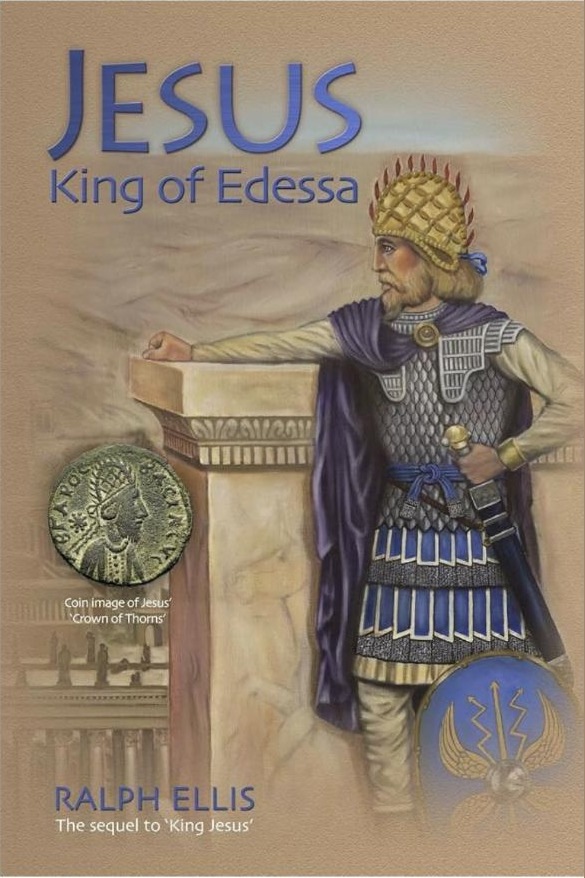
Jesus, King of Edessa
A first-century king in the historical record

King Jesus books
The Grail Cypher
The secrets of Arthurian history